

Americans celebrated the 100th, and the 200th, but not the 150th. Why wouldn’t the nation just have the patience to wait for the 300th anniversary of America? In any case, the celebration of 250 years of American independence goes on and, the number itself inspired Actors Under the Stars to wonder: What are the two hundred fifty best films of all time up until now? (Relax, this is not a listicle.)
There would be a lot of schools of thought, and not all of the films would be American movies. Of course, there were no motion pictures of any kind 250 years ago. So, let’s look at a little history, then see where we are now.
Going to the Movies for the First Time
More than 100 years after the U.S. Revolutionary War victory in 1776, French inventor Louis Le Prince produced what can be considered the first motion picture. Roundhay Garden Scene of 1888 is a joyous, soundless two seconds of some well-dressed people strutting around an English garden. This was the first time actual motion was recorded rather than just a series of stills presented in rapid succession to simulate motion.
However, most of us are more familiar with the name “Lumière.” With their patented Cinématographe camera, the French Lumière brothers were among the earliest filmmakers. They produced ten short films which thirty or so presumably excited people each paid one franc to view in a Parisian café. The motion pictures were a bit longer than Roundhay Garden Scene; each film ran about 50 seconds. Viewing these films of less than one minute in length made this audience the initial paying public at a screening, and history immortalizes these moments in 1895 as the first time people went to the movies!
Today, we don’t always go to the movies. More often the movies stream to us. However we come to experience them, if you’re going to determine the 250 best movies yet made, you’re going to encounter a lot of opinions. AutS has chosen to focus the lens on the top best lists of four rating sources. This way, we’ll see some balance. You can visit the sites yourself and view the full lists. Here, we’ll examine some of what they have in common, how they differ, and what AutS found to be the biggest surprises.
 IMDb: uses a consensus of the opinions of accredited film critics and cinephiles from the general public, plus nods from movie industry professionals reflected by awards given
Rotten Tomatoes: ratings are a combo of their Tomatometer (pro critics) and Popcornmeter (general movie fans)
Metacritic: weighs reviews of professional critics only
yFilm Guide: results are an aggregate using a mathematical formula to combine multiple rating factors from multiple sources
All of the rankings are as of the time of this writing.
Okay, you probably guessed it. The Godfather (1972) is #1 on three of the lists (ranking #9 on Metacritic). I know I am

probably going to lose any fan AutS may ever have had, but I must make a confession. Though it is uniquely American and masterful — and it is almost an understatement to call it iconic — I do not even like this film. The acting, cinematography, etc., etc. are all great; but for me as a viewer, the cruelties and moral decay are an irredeemably oppressive experience.
Because AutS always has eyes trained on the supporting actors (and for other reasons that are obvious if you know the movie) the horse head scene is the most vivid thing I remember. John Marley gives a provocative performance as a despicable character who becomes the victim, along with the horse, in that scene. Am I the only one who does not revere the Godfather movies?
The one dissenting conclusion, at Metacritic, places Deckalog in the very top spot. More about that in a moment.

The last of the best is a potpourri, and none of the films are American. That same Deckalog that was #1 at Metacritic finds itself at #250 on the IMDb. It isn’t a movie exactly; it’s ten films linked together in a ten-commandments-theme, in the poetic style of acclaimed director Krzysztof Kieslowski (of Three Colours trilogy fame). It was presented as a Polish TV mini-series (1989-1990).
Moolaadé (2004) was chosen at Metacritic as the last of the two hundred fifty best. Produced in collaboration amongst several French-speaking African nations, the film is a visually beautiful, fictionalized story dealing with the inconceivably barbaric practice of female genital mutilation. It is probably not surprising that I have not seen this one but, despite the brutality at its core, the New York Times said, “to skip Moolaadé would be to miss an opportunity to experience the embracing, affirming, world-changing potential of humanist cinema at its finest.”
The conglomerate balancing of Rotten Tomatoes comes up with an Indian Bengali masterpiece in this slot, Jalsaghar which translates to The Music Room (1960), and yFilm Guide rounds out the #250 slot with the road trip dramedy Y Tu Mama Tambien (2001) from Mexico.
The two youngest entries into the lists of immortals are both from merely last year. Despite the recency of its introduction into the family of cinema Sinners made its way onto Rotten Tomatoes at #38.
This is due, in part, to the fact that the film garnered the most Oscar nominations ever for a

single motion picture, including the bid of Delroy Lindo’s riveting performance as Best Supporting Actor.
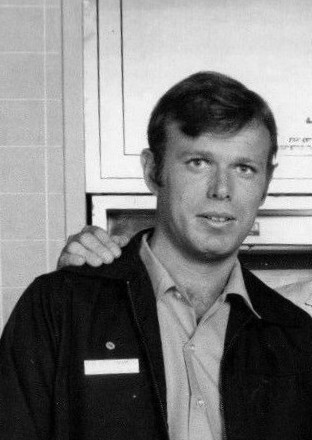
One Battle After Another, also from 2025, sits at #86 on Metacritic. It’s a highly praised, socio-political action thriller permeated with juicy dark humor; but AutS was drawn to it because of long-time actor Kevin Tighe. Tighe has worked quietly and steadily ever since his co-starring role on a TV series in the 1970s. To see his career trajected from that clean-cut young breakthrough role on Emergency to the amusingly blithering and thoroughly vile wealthy backroom villain he portrays in a single little scene in One Battle… is fascinating.
Moving on to the very oldest entry, we find the silent Birth of a Nation (1915) resting at #142 on the IMDb. With a runtime of 3 hours and 15 minutes, this epic was made just twenty years after the Lumières’ embryonic 50-second features and remains notable for its concoction of dazzling virtuosity, box office success, stunning racist
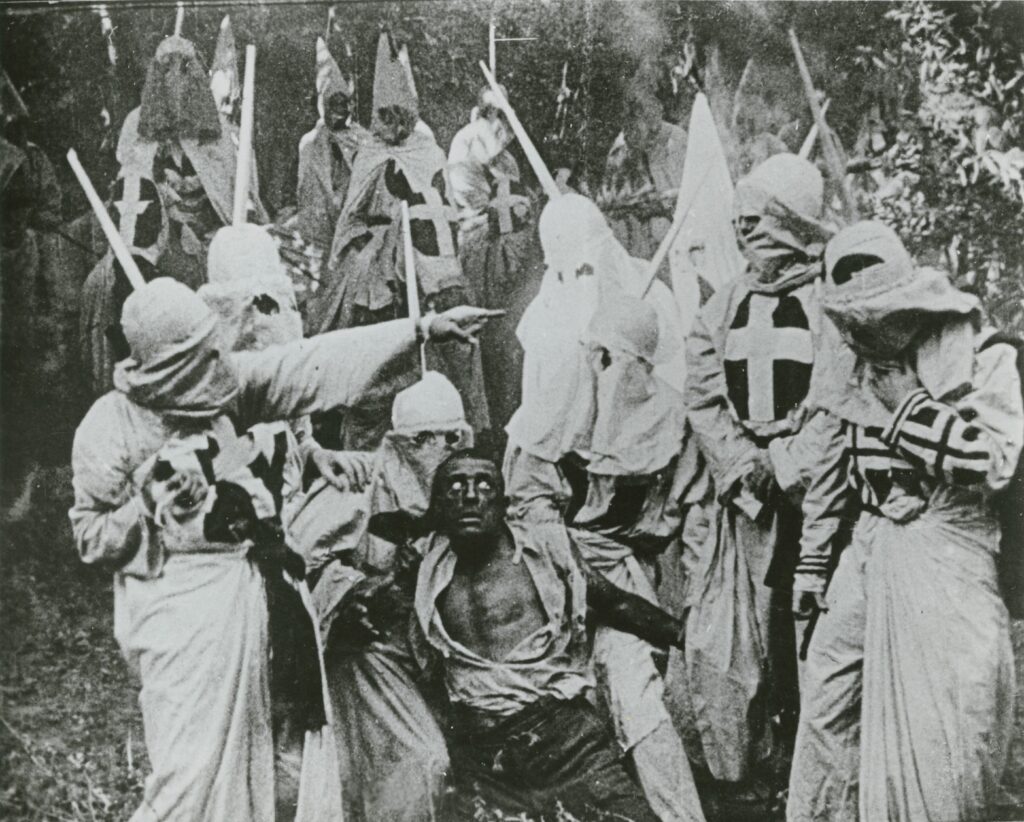
depictions, and landmark influence on filmmaking. It was deemed in the 2004 book American Racist from University Press of Kentucky to be, “the most controversial film ever made in the United States.”
Indisputables (?) Ranked
Cult film director John Waters once quipped, “Faster Pussycat, Kill, Kill! [directed by Russ Meyer] is, beyond a doubt, the best movie ever made,” then cheekily expanded, “possibly better than any film that ever will be made in the future.” Ummm…okay. But maybe we can just take a look at a few other contenders one might think of when pondering the number one best movie ever produced.
No doubt, some would choose Gone with the Wind (1939). Much criticized in recent times for its idealized presentation of the antebellum South, this masterpiece ranked #10 on the IMDb. It ranked much further down on both Metacritic and yFilm Guide, and is absent altogether on Rotten Tomatoes.

Many loyalties would have to lie with The Wizard of Oz (1939). The childhood classic rates in the top 50 on three of the sites and much further down on the exclusively professional reviewers’ Metacritic.
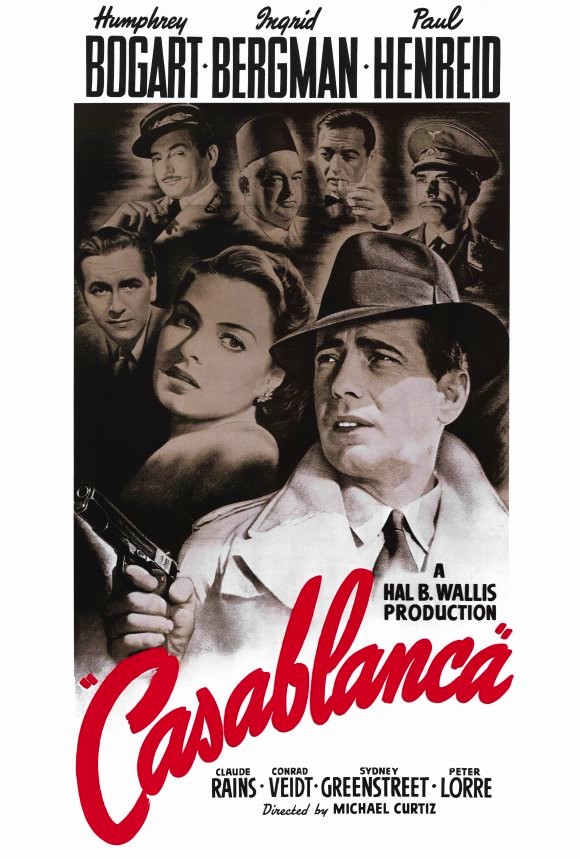
Casablanca (1942) cannot be discounted. It appears in the top 20 on all of the rating services here and Orson Welles’ opus magnum Citizen Kane (1941) is universally in the top 25!
Even the simple, barebones 12 Angry Men (1957) receives great consideration. Rated among the top 65 on all the sites, and very near the top on Rotten Tomatoes, 12 Angry Men scores at #2 of the best of all time at yFilm Guide. (The magic of that film for me is that I unexpectedly see chunks of myself in every one of those guys — without exception.)
Actors Under the Stars & Stripes
As the fragility of hard-fought-for American freedoms is particularly prominent in our awareness right now, we’ll end our exploration with one of the films that can make you feel the most of what it is to be American. Whatever the selection, it was bound to be a ponderous decision and a controversial choice. Nevertheless, the movie occupies position #144 on Rotten Tomatoes of the best motion pictures of any kind, and AutS chooses it as the patriotic favorite: Mr. Smith Goes to Washington (1939).
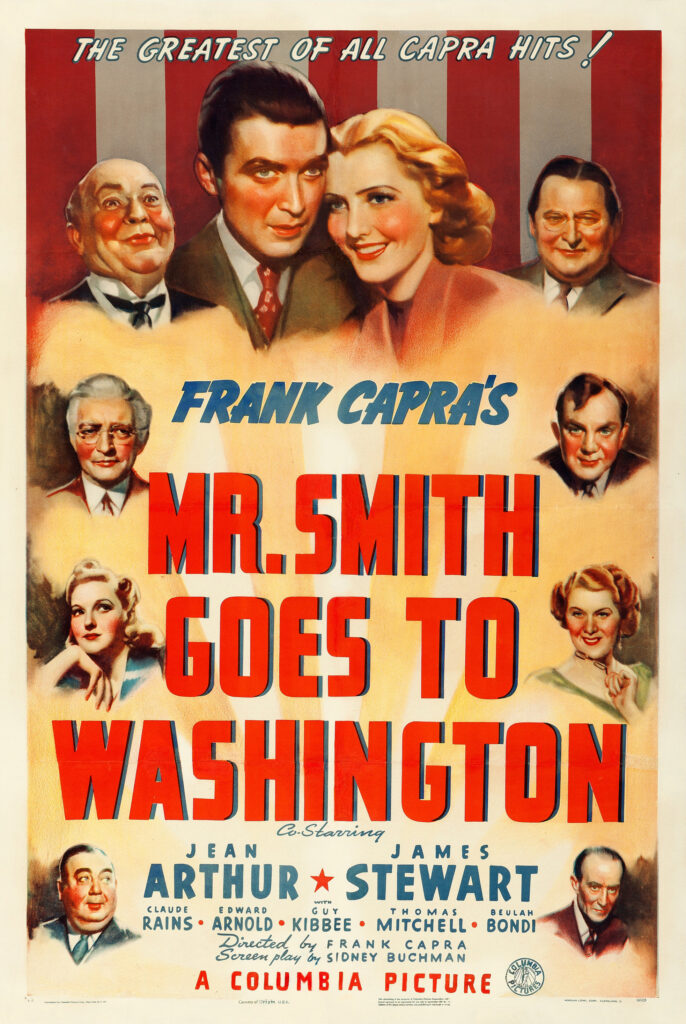
There is a warning. In order to open yourself to the experience, you need to see past the cultural and societal shackles in operation in the era when this feature was made. The film brandishes the word “men” countless times where, today, the concept would be “people;” and aside from occasional service workers, ethnic diversity only appears in sprinkles. That said, the film has a jangly, lighthearted start, but the conviction of the title character (played by beloved James Stewart) that goodness and justice must be fought for against greed, and suppression, and all odds is a resonant, mindset-forming premise that the film develops and arcs with both humor and dynamism.
The filibuster scene is a wrencher and a triumph, and there are almost enough wonderful character actors in it to stretch from sea to shining sea. Happy 250th birthday, America!
~ FW